
Are you ready to unlock the full potential of your business by harnessing the power of artificial intelligence and machine learning?
In today’s fast-paced business landscape, companies are constantly seeking ways to streamline operations, reduce costs, and improve efficiency. Data-driven decision-making is at the forefront of this endeavor, and AI technologies are revolutionizing the way businesses operate.
By leveraging AI and machine learning, businesses can automate complex tasks, minimize errors, and provide 24/7 availability for critical functions. This comprehensive guide will walk you through the practical steps to implement AI in your organization.
Key Takeaways
- Discover how AI is transforming business operations across industries.
- Learn about the evolution of AI from simple reactive machines to sophisticated learning systems.
- Understand how data-driven AI solutions can reduce operational costs and improve efficiency.
- Get actionable steps to begin your AI implementation journey.
- Explore the practical steps to implement AI in your organization.
Understanding Artificial Intelligence and Its Evolution
Artificial intelligence is no longer a futuristic concept; it’s a present-day reality that’s transforming the way businesses operate. As you navigate the complexities of modern business, understanding AI and its evolution is crucial for making informed decisions about its adoption and integration into your operations.
Defining Artificial Intelligence in Today’s Business Context
In the context of today’s business landscape, artificial intelligence refers to a set of technologies that enable computers to perform advanced functions, such as analyzing data, making recommendations, and understanding spoken and written language. As noted by experts, “AI is the backbone of innovation in modern computing, unlocking value for individuals and businesses.” This definition goes beyond the hype and science fiction portrayals, providing a clear understanding of what AI truly means for businesses.
From Reactive Machines to Self-Aware Systems: The AI Spectrum
The evolution of AI has been remarkable, from simple rule-based systems to sophisticated learning algorithms that can simulate aspects of human intelligence and decision-making. The AI spectrum ranges from narrow AI, focused on specific tasks, to the theoretical concept of artificial general intelligence that could match human cognitive abilities. Modern business AI systems utilize neural networks and deep learning to process information in ways that mimic the human brain’s structure, enabling businesses to automate complex processes that previously required human judgment.
As AI continues to advance, understanding where your business fits in the AI adoption curve is essential. This involves recognizing the level of AI technology most appropriate for your needs and leveraging AI models that are becoming increasingly sophisticated. By doing so, you can harness the power of AI to drive innovation and efficiency in your business operations.
Core Technologies Powering Modern AI
The backbone of modern AI systems lies in three core technologies: machine learning, deep learning, and natural language processing. These technologies work together to enable businesses to automate complex tasks, gain insights from data, and improve customer interactions.
Machine Learning: The Foundation of Business AI
Machine learning is a subset of AI that uses algorithms to train data and obtain results without being explicitly programmed. It forms the foundation of business AI applications, enabling systems to learn from data and improve over time. There are three primary machine learning approaches: supervised, unsupervised, and reinforcement learning.
Supervised learning involves training models on labeled data to make predictions. Unsupervised learning identifies patterns in unlabeled data. Reinforcement learning trains models through trial and error by rewarding desired behaviors.
Deep Learning and Neural Networks
Deep learning is a subset of machine learning that uses multilayered neural networks, called deep neural networks, to simulate the complex decision-making power of the human brain. These networks process information through multiple layers to identify complex patterns that simpler algorithms might miss.
As “Deep learning is revolutionizing the field of AI by enabling machines to perform tasks that were previously thought to be exclusive to humans.” This technology has shown remarkable success in image and speech recognition, natural language understanding, and other areas.
Natural Language Processing for Business Communication
Natural Language Processing (NLP) enables machines to understand and respond to human language. NLP technologies allow businesses to automate customer communications, analyze sentiment, and extract valuable insights from text data.
By leveraging NLP, companies can implement chatbots, analyze customer feedback, and improve their overall customer service experience. As NLP continues to evolve, it is becoming increasingly important for businesses looking to stay competitive in a rapidly changing landscape.
These core technologies work together to create AI systems that can handle increasingly complex business tasks. By understanding how machine learning, deep learning, and NLP work together, businesses can identify which AI technologies align best with their objectives and data resources.
How Artificial Intelligence Transforms Business Operations
AI is transforming the business landscape by automating routine tasks, providing valuable insights, and supporting informed decision-making. This transformation is not limited to simple rule-based processes but extends to complex workflows that require learning and adaptation.
Automation of Repetitive Tasks and Workflows
Artificial intelligence can automate routine, repetitive, and often tedious tasks, including digital tasks such as data collection, data entry, and preprocessing, as well as physical tasks like warehouse stock-picking and manufacturing processes. By automating these tasks, businesses can free up human resources to focus on higher-value, more creative work.
For instance, AI-powered automation can handle complex workflows that require learning and adaptation, such as:
- Processing large datasets to identify patterns and trends
- Optimizing business processes through predictive analytics
- Enhancing customer service through chatbots and virtual assistants
Enhanced Decision-Making Through Data Analysis
Whether used for decision support or fully automated decision-making, AI enables faster, more accurate predictions and reliable, data-driven decisions. Machine learning algorithms can analyze massive amounts of business data to identify patterns and relationships that humans might miss.
Here’s an example of how AI enhances decision-making:
| Decision-Making Aspect | Traditional Approach | AI-Powered Approach |
|---|---|---|
| Data Analysis | Manual analysis, limited by human capacity | Automated analysis, handling large datasets |
| Predictive Insights | Based on historical data, limited forecasting | Predictive analytics, anticipating market changes |
| Decision Speed | Time-consuming, prone to human error | Faster, more accurate predictions |
By leveraging AI for data analysis, businesses can gain valuable insights, anticipate market changes, and make informed decisions.
Key Benefits of Implementing AI in Your Business
Implementing artificial intelligence in your business can revolutionize operations by automating repetitive tasks and enhancing decision-making processes. This technological advancement is not just about replacing human labor; it’s about augmenting capabilities to achieve increased operational efficiency and accuracy.
Increased Operational Efficiency and Cost Reduction
By automating time-consuming tasks, AI can significantly reduce the time spent on mundane activities, allowing your team to focus on strategic initiatives. This leads to increased operational efficiency and substantial cost savings. AI-driven automation streamlines complex workflows, making your business more agile and responsive to market demands.
Error Reduction and Quality Improvement
AI systems are designed to perform tasks with high accuracy, reducing the likelihood of human error. By maintaining consistent performance over extended periods, AI can improve quality control by detecting subtle defects or anomalies that human inspectors might miss. This results in error reduction and enhanced product quality.
24/7 Availability and Consistent Performance
One of the significant advantages of AI is its ability to operate 24/7 availability without breaks or fatigue. This capability transforms your business, especially in areas like customer service and global operations, where continuous support is crucial. AI ensures consistent performance, providing a reliable and efficient service to your customers.
| Benefits | Description | Impact |
|---|---|---|
| Increased Operational Efficiency | Automation of repetitive tasks | Cost savings and strategic focus |
| Error Reduction | High accuracy in task performance | Improved quality control |
| 24/7 Availability | Continuous operation without fatigue | Enhanced customer service |
By leveraging artificial intelligence and intelligence technologies, your business can achieve significant improvements in efficiency, quality, and customer satisfaction. As you consider implementing AI solutions, you’ll be able to quantify the potential return on investment and make informed decisions about your business’s future.
Practical Applications of AI for Business Automation
Businesses in Mexico are increasingly adopting artificial intelligence to automate key processes and enhance customer experiences. This trend is driven by the need for efficiency, cost reduction, and improved customer satisfaction.
The use of AI-powered solutions is transforming various aspects of business operations, from customer service to financial management and marketing strategies.
Customer Service: Chatbots and Virtual Assistants
One of the most significant applications of AI in customer service is the deployment of chatbots and virtual assistants. These tools utilize natural language processing (NLP) to understand and respond to customer inquiries 24/7, significantly reducing support costs while improving response times.
By automating routine customer interactions, businesses can free up human resources for more complex and value-added tasks, enhancing overall customer experience.
Finance and Security: Fraud Detection and Risk Management
In the finance sector, AI is being used to detect fraudulent transactions and enhance security measures. Machine learning models analyze patterns in financial data to identify anomalies that may indicate fraudulent activity, such as unusual spending patterns or login locations.
This proactive approach to risk management helps businesses protect their assets and maintain customer trust.
Marketing: Personalized Customer Experiences
AI is also revolutionizing marketing strategies by enabling businesses to create highly personalized customer experiences. By analyzing behavioral data and predicting individual preferences, companies can tailor their marketing campaigns to specific customer segments, improving engagement and conversion rates.
The use of machine learning models to analyze data and drive marketing decisions represents a significant shift towards more targeted and effective marketing strategies.
In conclusion, the applications of AI in business automation are diverse and continue to expand. As businesses in Mexico and beyond adopt these technologies, they are likely to see significant improvements in efficiency, customer satisfaction, and overall competitiveness.
Implementing AI Solutions in Your Organization
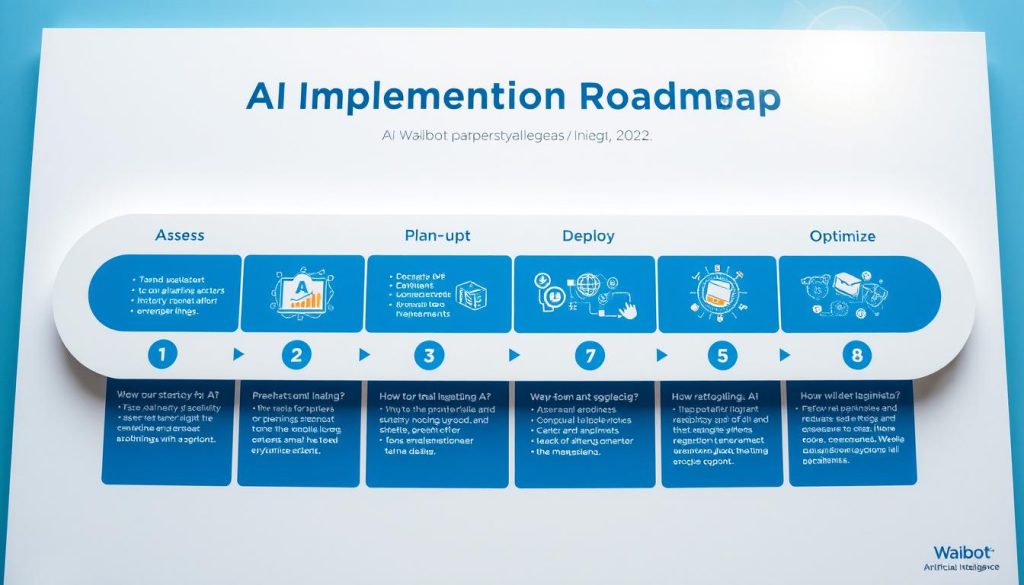
To successfully implement AI solutions, you must start by understanding your organization’s specific needs and opportunities. This involves a thorough assessment of your business processes to identify areas that could benefit most from artificial intelligence and machine learning.
Assessing Your Business Needs and Opportunities
Begin by identifying high-value processes that involve repetitive tasks, large data volumes, or complex decision points. These areas are prime candidates for AI automation. You’ll need to evaluate your current systems and infrastructure to determine their compatibility with potential AI solutions.
Choosing the Right AI Technologies and Tools
Once you’ve identified areas for AI implementation, you’ll need to choose the appropriate technologies and tools. This involves evaluating different machine learning models and AI platforms based on your specific business requirements, available data, and technical capabilities.
Integration Strategies for Existing Business Systems
Effective AI implementation requires seamless integration with your existing business applications and data sources. This may involve developing APIs or using middleware to connect new AI systems with legacy systems, ensuring a cohesive workflow.
To illustrate the integration process, consider the following table that outlines key considerations for AI system integration:
| Integration Factor | Description | Considerations |
|---|---|---|
| Data Compatibility | Ensuring data formats are compatible between old and new systems | Data standardization, conversion tools |
| API Development | Creating APIs for seamless communication between systems | API security, documentation, scalability |
| System Scalability | Ensuring that existing infrastructure can support new AI systems | Hardware upgrades, cloud solutions |
As you implement AI solutions, starting with small, well-defined projects can help deliver quick wins and build organizational confidence. Building the right team for AI implementation, whether through internal talent development, external partnerships, or a hybrid approach, is also crucial.
Overcoming Challenges in AI Adoption
The path to AI adoption is often paved with obstacles, including data security concerns and human-AI collaboration issues. As organizations integrate AI into their systems, they must navigate through various challenges to reap its benefits.
Data Security and Privacy Concerns
AI systems rely heavily on data, making them vulnerable to data poisoning, tampering, and cyberattacks. To mitigate these risks, organizations must prioritize data integrity and implement robust security measures throughout the AI lifecycle. This includes:
- Implementing robust governance frameworks to protect sensitive information
- Using technical safeguards such as encryption and access controls
- Regularly monitoring AI systems for potential security breaches
Managing the Human-AI Collaboration
Effective human-AI collaboration is crucial for the successful adoption of AI. Organizations must ensure that employees view AI systems as valuable tools rather than threats to their jobs. This can be achieved by:
- Providing training and upskilling programs to enhance employee AI literacy
- Fostering a culture of collaboration between humans and AI systems
- Communicating the benefits and limitations of AI to employees
Addressing Ethical Considerations and Bias
AI systems can perpetuate and even amplify existing biases if not designed with fairness and transparency in mind. Organizations must take steps to identify and mitigate potential bias in AI algorithms, ensuring that their AI systems treat all users equitably.
| Challenge | Mitigation Strategy |
|---|---|
| Data Security Concerns | Implement robust governance frameworks and technical safeguards |
| Human-AI Collaboration | Provide training and foster a collaborative culture |
| Ethical Considerations and Bias | Design AI systems with fairness and transparency in mind |
As AI continues to evolve, it’s essential for organizations to stay ahead of the curve by addressing these challenges proactively. By doing so, they can unlock the full potential of AI and drive business success.
“AI is not just a technology, it’s a catalyst for business transformation.”
By understanding and addressing the challenges associated with AI adoption, organizations can harness its power to drive innovation and growth.
AI Implementation Success Stories in Mexico

Companies in Mexico are leveraging artificial intelligence to drive business growth, improve customer experiences, and streamline operations. The adoption of AI technologies is transforming various sectors, from manufacturing to financial services and retail.
Manufacturing Sector Transformations
In the manufacturing sector, AI is being used for predictive maintenance, quality control, and supply chain optimization. For instance, a leading automotive manufacturer in Mexico implemented an AI-powered predictive maintenance system, reducing equipment downtime by 30% and increasing overall productivity.
Financial Services Innovation
Financial institutions in Mexico are utilizing machine learning models to enhance fraud detection, credit risk assessment, and customer service. By analyzing vast amounts of data, these institutions can now make more informed decisions and provide personalized services to their customers.
Retail and E-commerce Advancements
The retail and e-commerce sectors are also benefiting from AI applications. Companies are using AI to personalize customer experiences, optimize inventory management, and streamline logistics operations. For example, a major e-commerce platform in Mexico implemented an AI-driven recommendation engine, resulting in a 25% increase in sales.
These success stories demonstrate how Mexican companies across various industries are successfully implementing AI solutions, driving innovation, and improving their bottom line. By leveraging data and AI systems, businesses can gain a competitive edge and achieve significant returns on their investments.
Future Trends in Business AI and Automation
As we look to the future, artificial intelligence is poised to revolutionize business automation in ways both profound and unexpected. The landscape of business operations is on the cusp of a significant transformation, driven by advancements in AI technologies.
Generative AI and Its Business Applications
Generative AI, sometimes referred to as “gen AI,” is making significant strides in business automation. This technology involves deep learning models that can create complex, original content such as long-form text, high-quality images, and realistic video or audio in response to user prompts. According to experts, “Generative AI has the potential to automate tasks that were previously thought to be the exclusive domain of humans,” thereby enhancing productivity and efficiency. Businesses can leverage generative models to synthesize information and generate novel solutions to complex problems.
AI Agents and Agentic Systems for Complex Tasks
The development of AI agents and agentic systems represents another significant trend in business AI. An AI agent is an autonomous program that can perform tasks and achieve goals without human intervention by designing its own workflow and utilizing available tools. Agentic AI systems, comprising multiple coordinated AI agents, can accomplish complex tasks that surpass the capabilities of individual agents. This technology has the potential to transform various business functions, from customer service to financial management.
To prepare for these emerging trends, businesses should focus on developing their data strategy and enhancing their technology infrastructure. By doing so, they can harness the power of AI to drive innovation and stay competitive in a rapidly evolving market.
Conclusion: Taking the First Steps Toward AI-Powered Business Transformation
The journey to AI-powered business transformation begins with a single step, informed by the insights you’ve gained. You’ve now gained a comprehensive understanding of how artificial intelligence can transform your business operations through automation, enhanced decision-making, and improved customer experiences.
To start your AI journey today, identify a specific business challenge that could benefit from intelligent automation. Consider how machine learning models can process complex data types to drive business insights. By taking small, strategic steps, you can harness the power of AI technologies to drive business transformation.
As you move forward, remember that successful AI implementation is a journey, not a destination. Stay informed about emerging trends, such as generative AI and AI agents, to continue innovating in this rapidly evolving field.
FAQ
Q: What is the role of Machine Learning in business automation?
A: Machine Learning is a fundamental technology that enables businesses to automate complex tasks, improve decision-making, and enhance customer experiences. By analyzing large datasets, Machine Learning algorithms can identify patterns and make predictions, allowing businesses to optimize their operations.
Q: How does Deep Learning differ from traditional Machine Learning?
A: Deep Learning is a subset of Machine Learning that uses Neural Networks to analyze complex data, such as images, speech, and text. Deep Learning models can learn and improve on their own, enabling businesses to tackle challenging tasks, like Computer Vision and Natural Language Processing.
Q: What are the benefits of using Virtual Assistants in customer service?
A: Virtual Assistants, powered by AI, can provide 24/7 customer support, helping businesses to improve customer satisfaction and reduce support costs. They can also help with tasks, such as answering frequently asked questions, routing customer inquiries, and providing personalized recommendations.
Q: How can Generative Models be used in business applications?
A: Generative Models, a type of AI technology, can be used to create new content, such as images, videos, and text. Businesses can leverage Generative Models to automate content creation, improve product design, and enhance customer experiences.
Q: What are the key considerations when implementing AI solutions in an organization?
A: When implementing AI solutions, businesses should assess their needs and opportunities, choose the right AI technologies and tools, and develop effective integration strategies. They should also address concerns, such as Data Security and Privacy, and ensure that their AI systems are transparent and fair.
Q: How can businesses ensure the accuracy and reliability of their AI systems?
A: To ensure the accuracy and reliability of their AI systems, businesses should focus on high-quality training data, robust testing and validation, and ongoing monitoring and maintenance. They should also implement Data Quality controls and address potential biases in their AI models.
No Responses